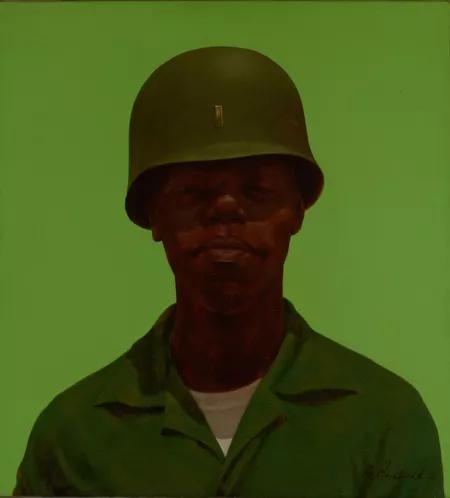
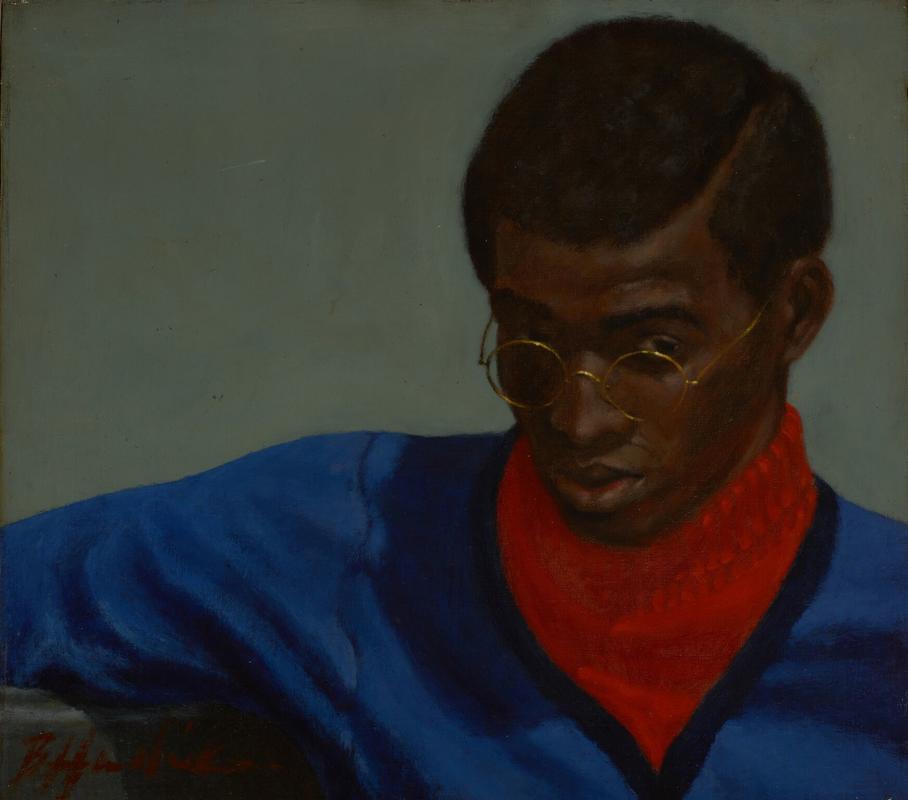
Barkley Hendricks' early portraits are a profound testament to his unique talent and vision, which set the stage for his celebrated career. Born in North Philadelphia in 1945, Hendricks' journey into the art world was deeply influenced by his formative trip to Europe in 1966, during his time at the Pennsylvania Academy of the Fine Arts. It was here, amidst the masterworks of Old Masters and early Modern paintings, combined with his early exposure to the charisma of musicians like Nina Simone and Miles Davis, that Hendricks began to develop what would later be recognized as his signature style of "cool realism" (Artsy) (www.wikiart.org).
Hendricks' earliest work, such as "Toast of Amos" (1966), showcases his ability to capture the essence of his subjects with a dynamic, layered complexity. His subjects, often friends, relatives, or individuals he encountered, are depicted with a dignified presence, set against monochromatic backdrops that emphasize their self-assurance and style. This approach was not only groundbreaking in terms of aesthetic but also in how it communicated a new assertiveness and pride among Black Americans during the era of the Black Power movement (Artsy).
One of Hendricks' most renowned early portraits, "Lawdy Mama" (1969), further exemplifies his innovative blend of contemporary life with historical art forms. The portrait features his second cousin in a modern attire surrounded by a gold leaf, reminiscent of Byzantine icons, against an arched canvas. This work, among others, not only challenged the traditional representations of Black Americans in art but also introduced a new narrative, one that celebrated the individuality and the inherent worth of his subjects (www.wikiart.org).
Throughout his early career, Hendricks continued to explore and refine his technique, employing elements from 1950s abstraction, street photography, and Old Master techniques such as chiaroscuro. His portraits from this period, such as "Northern Lights" (1976), are notable for their confident sense of style and the nuanced portrayal of his subjects. Hendricks' work from this era laid the foundation for his influence on later artists and his pivotal role in the representation of Black figures in contemporary art (Artsy) (Wikipedia).
Despite his explicitly apolitical stance, Hendricks occasionally ventured into political commentary, as seen in works like "FTA" (1968) and "Roscoe" (2016), reflecting on the social and political climate of the times. His early portraits not only showcased his extraordinary talent and innovative approach but also marked the beginning of a distinguished career that would continue to inspire and influence for decades (Artsy).
Hendricks' legacy is housed in some of the most prestigious collections, including the National Gallery of Art, the Philadelphia Museum of Art, the Studio Museum in Harlem, and the National Endowment for the Arts. His early portraits stand as a testament to his unique ability to merge American realism and post-modernism, capturing the essence of his era and beyond (www.wikiart.org).