
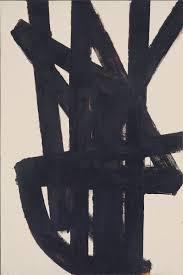
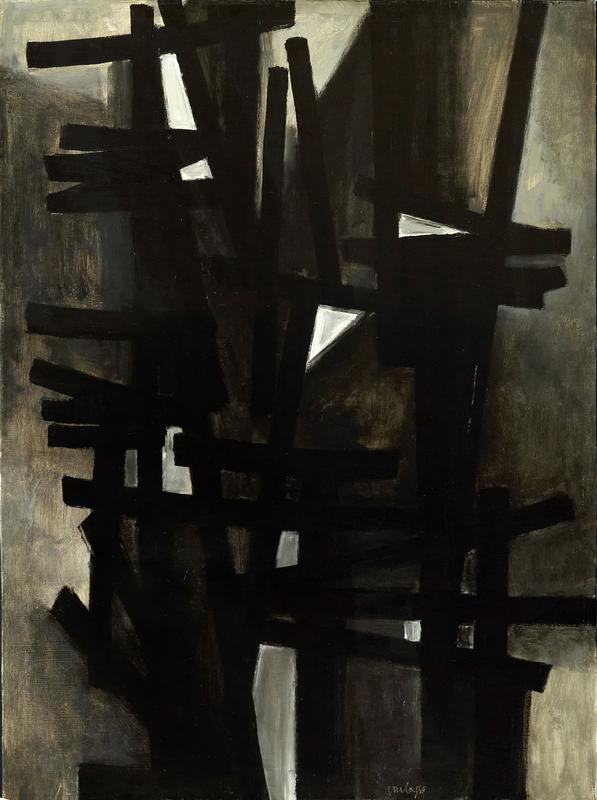
Pierre Soulages' pre-Outrenoir phase, spanning from 1946 to 1979, marks a period of intense exploration and innovation, setting the groundwork for his later works and contributions to abstract art. This phase is characterized by Soulages' deepening engagement with abstraction and the expressive potential of black, a color that would become central to his entire oeuvre.
After World War II, Soulages moved to Paris and began to establish himself as a formidable presence in the art world. His early works from this period exhibit a bold, gestural style that reflects the influence of Art Informel and Abstract Expressionism, movements that emphasized the emotional and physical act of painting. Soulages was fascinated by the textures and rhythms of nature, as seen in his depictions of tree branches against stark winter skies. These early paintings already hinted at his interest in the dramatic interplay between light and dark, a theme that would dominate his later work.
Throughout the 1950s and 1960s, Soulages experimented with various materials and techniques, including walnut stain on paper, which allowed him to explore different textures and forms. He developed a signature style characterized by thick, black brushstrokes against lighter backgrounds. These works, often large in scale, were not merely abstract but sought to evoke the raw, primal energy of nature and the ancient past. Soulages' use of black became more nuanced during this period, as he investigated its capacity to absorb and reflect light, thereby creating a sense of depth and space within the flat plane of the canvas.
Soulages gained international recognition during this pre-Outrenoir phase, exhibiting across Europe and the United States. His art was celebrated for its powerful simplicity and its ability to conjure vast emotional and existential landscapes. In these years, Soulages also engaged in various projects outside traditional canvas painting, including set and costume design for theater and ballet, showcasing his versatility and creative vision.
By the late 1970s, Soulages' exploration of black reached a pivotal moment. He began to focus increasingly on the texture of his paintings and the way surfaces interacted with light. This period marked a transition towards what he would later call "Outrenoir" or "beyond black," a term that encapsulates his unique approach to using black not as a color but as a luminous material. The pre-Outrenoir phase is thus crucial for understanding Soulages' artistic journey, as it encapsulates his evolving relationship with black—transitioning from its use as a dominant color to a medium through which light is explored and expressed.
The pre-Outrenoir phase of Pierre Soulages' career is a testament to his profound impact on the development of post-war European abstract art. His relentless pursuit of new methods to express the depth and intensity of black prefigured his Outrenoir works, which would solidify his place as one of the most innovative and influential artists of the 20th century.