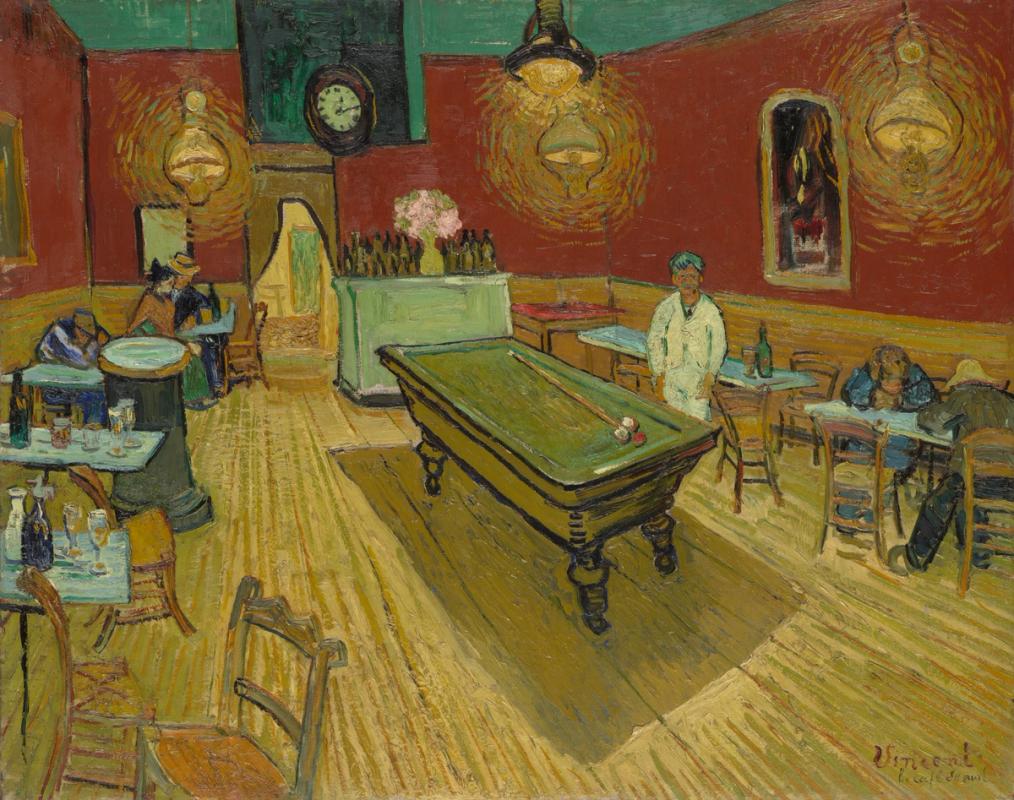
Vincent van Gogh's The Night Café is one of his most evocative and psychologically charged paintings, created during his stay in Arles in September 1888. The painting is a striking exploration of the themes of alienation, emotional turmoil, and the darker side of human nature. Van Gogh's depiction of the café interior, with its vivid colors and distorted perspective, reflects his intent to convey the atmosphere of a place where people could "ruin themselves, go mad, or commit a crime" (Encyclopedia Britannica) (The Metropolitan Museum of Art).
The setting of The Night Café is the Café de l'Alcazar in Arles, a local establishment that van Gogh frequented. The painting portrays an interior lit by glaring gas lamps, with a floor that tilts steeply toward the viewer, adding to the disorienting effect. The walls are a deep red, contrasting sharply with the green ceiling and the yellow floor, creating a color scheme that van Gogh used deliberately to evoke feelings of unease and discomfort. The colors clash violently, reflecting van Gogh's interest in the psychological impact of color and his desire to express the oppressive atmosphere of the café (Encyclopedia Britannica) (Van Gogh Biography).
The figures in the painting—lonely, isolated patrons and a detached bartender—are depicted with a sense of detachment, further emphasizing the sense of alienation. Unlike the warm, inviting atmosphere typically associated with cafés, van Gogh's The Night Café presents a scene of bleakness and despair. The distorted perspective and the unsettling color contrasts are techniques van Gogh used to convey his own emotional state during a period of intense personal struggle. This painting is a testament to van Gogh's ability to use his art as a means of expressing his inner turmoil (The Metropolitan Museum of Art) (vangoghgallery).
In a letter to his brother Theo, van Gogh described The Night Café as one of the ugliest paintings he had ever made, yet he considered it one of his most successful attempts at expressing the "terrible passions of humanity" through the use of color and composition. The work is often seen as a precursor to the Expressionist movement, which would later explore similar themes of psychological depth and emotional intensity (vangoghgallery).
The Night Café is also significant for its innovative use of perspective and color, which broke away from the more traditional approaches of the time. The painting's skewed perspective and intense color contrasts would go on to influence future generations of artists, solidifying van Gogh's role as a pioneer of modern art. Today, The Night Café is considered one of van Gogh's masterpieces, not only for its technical brilliance but also for its profound emotional impact (Encyclopedia Britannica) (Van Gogh Biography).