
Vincent van Gogh's time in Arles, from February 1888 to May 1889, represents one of the most productive and artistically significant periods of his career. During his stay in this small town in the south of France, van Gogh produced over 200 paintings, along with numerous drawings and watercolors. The vibrant light and color of the Provençal landscape profoundly influenced his work, leading to some of his most iconic paintings.
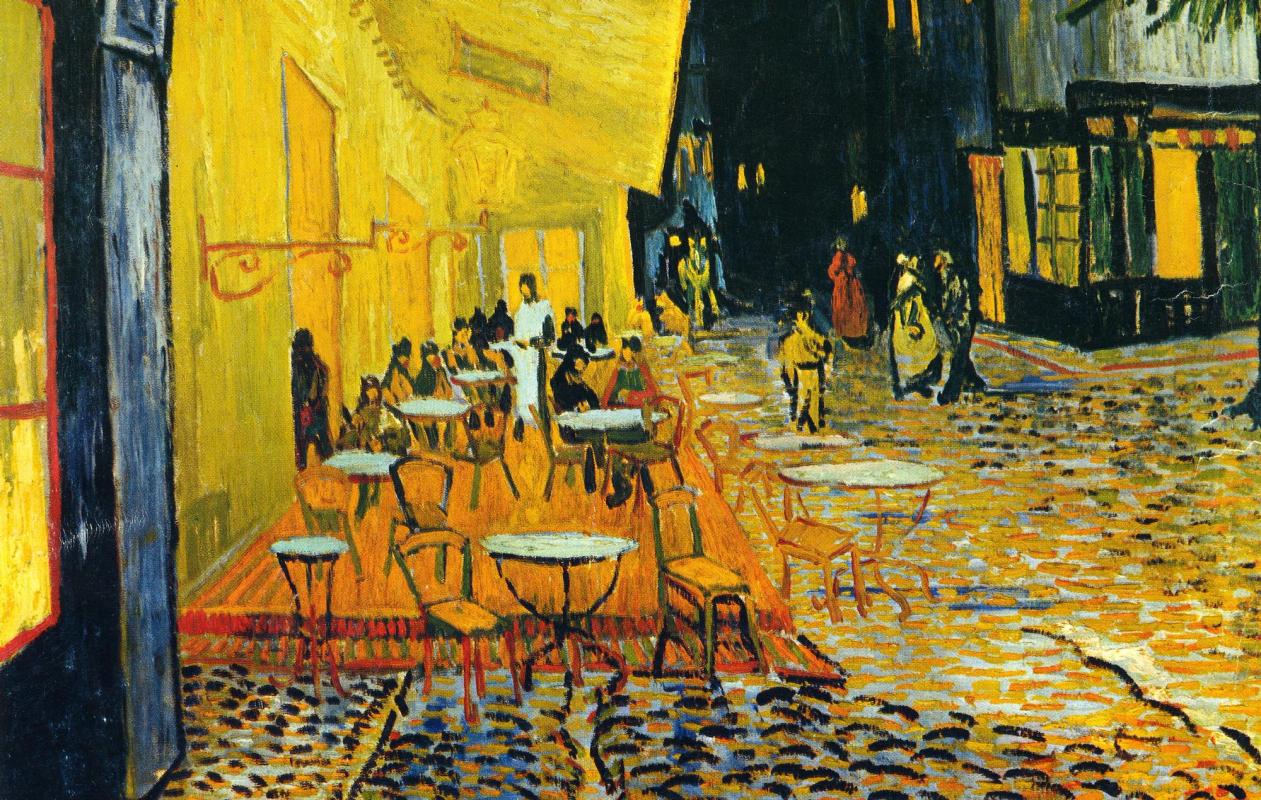
One of the key themes in van Gogh's Arles paintings is his exploration of color. The intensity of the sunlight in Arles allowed van Gogh to experiment with brighter, more saturated colors than he had used previously. This is evident in works such as "The Café Terrace at Night" (1888), where he used contrasting colors like the vivid yellows and blues to capture the glow of the nighttime scene. The painting's dynamic composition and the interplay of light and shadow highlight van Gogh's evolving mastery of color theory, a hallmark of his Arles period (The Metropolitan Museum of Art).
Another significant aspect of van Gogh's Arles paintings is his focus on everyday subjects, which he rendered with emotional intensity and a unique artistic vision. For example, "The Bedroom" (1888) depicts van Gogh’s simple bedroom in the Yellow House, but the way he painted it—with its bold colors and skewed perspective—conveys a sense of tranquility and personal refuge. Similarly, "The Night Café" (1888) captures the interior of a local café with an almost oppressive atmosphere, using a striking combination of red and green tones to evoke feelings of unease and isolation. These paintings are more than mere depictions of spaces; they are deeply expressive works that reflect van Gogh's inner life during his time in Arles (Encyclopedia Britannica) (vangoghgallery).
The Arles period is also notable for van Gogh's iconic sunflower paintings. He created several versions of "Sunflowers" (1888–1889) during this time, initially as decorations for the room of his friend and fellow artist Paul Gauguin, who was expected to join him in Arles. These works are characterized by their vibrant yellow tones and thick application of paint, which give the flowers a sense of life and movement. The sunflowers became symbolic of van Gogh's artistic aspirations and his complex relationship with Gauguin, who ultimately did come to Arles, albeit briefly (Van Gogh Biography).
Van Gogh’s time in Arles was also marked by his attempts to capture the rural life and natural beauty of the region. Paintings such as "The Sower" (1888) and "Harvest in Provence" (1888) reflect his deep connection to the agricultural landscapes around Arles. These works often feature expansive fields under vast skies, rendered in vibrant colors and expressive brushstrokes. Van Gogh was deeply inspired by the cyclical nature of rural life, and these paintings express both the vitality and the harsh realities of the countryside (The Metropolitan Museum of Art) (vangoghgallery).
Despite the artistic successes of his Arles period, van Gogh's mental health began to deteriorate during this time. The tension between him and Gauguin, along with his increasing isolation, culminated in the infamous incident in December 1888 when van Gogh mutilated his ear. This event led to his voluntary admission to the Saint-Paul-de-Mausole asylum in Saint-Rémy-de-Provence in May 1889, effectively ending his time in Arles. Nevertheless, the works he produced during this period remain some of the most celebrated in his entire oeuvre, reflecting a critical moment in his artistic development and his enduring legacy (Encyclopedia Britannica) (Van Gogh Biography).