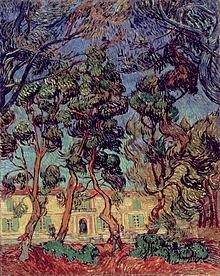

Vincent van Gogh's Saint-Paul Asylum, Saint-Rémy series represents a critical phase in his artistic career, marked by both intense creativity and personal struggle. Van Gogh voluntarily entered the Saint-Paul-de-Mausole asylum in Saint-Rémy-de-Provence in May 1889, following a period of deteriorating mental health, including the infamous incident where he mutilated his ear. During his year-long stay at the asylum, van Gogh created approximately 150 paintings, many of which are considered masterpieces today. This series is characterized by its exploration of nature, the surrounding landscape, and van Gogh's own emotional and psychological state (Encyclopedia Britannica) (The Metropolitan Museum of Art).
One of the most famous paintings from this period is The Starry Night (1889), which was inspired by the view from his window at the asylum. The painting captures the night sky with swirling clouds, a bright crescent moon, and shining stars, all rendered in van Gogh's characteristic bold, dynamic brushstrokes. The cypress tree in the foreground, reaching up towards the sky, adds a sense of connection between the earth and the heavens. This work, with its intense colors and almost surreal composition, reflects van Gogh's inner turmoil as well as his fascination with the natural world (The Metropolitan Museum of Art) (vangoghgallery).
In addition to The Starry Night, van Gogh painted several other notable works during his time at Saint-Rémy, including Irises (1889) and Wheatfield with Cypresses (1889). Irises is a vibrant depiction of the flowers in the asylum's garden, painted with van Gogh's signature expressive brushwork and vivid color palette. The painting conveys both the beauty of nature and a sense of tranquility, which contrasts with the artist's often chaotic inner life. Wheatfield with Cypresses is another masterpiece from this period, showcasing the Provençal landscape with its swirling skies, golden wheat fields, and dark, towering cypress trees. This painting, like many others from the Saint-Rémy series, combines realism with the emotional intensity that van Gogh was known for (Encyclopedia Britannica) (Van Gogh Biography).
Van Gogh's time at the asylum was also marked by a deep engagement with the works of other artists. He created a series of paintings that were reinterpretations of works by artists he admired, such as Rembrandt, Delacroix, and Millet. These "copies," as van Gogh referred to them, were not mere imitations but rather reinterpretations that allowed him to explore new techniques and express his own emotions through the works of others. One such example is Pietà (after Delacroix), where van Gogh took inspiration from Delacroix’s composition but infused it with his own intense emotional expression (The Metropolitan Museum of Art) (vangoghgallery).
The Saint-Paul Asylum, Saint-Rémy series is a testament to van Gogh's resilience and creativity during a period of profound personal difficulty. Despite the challenges he faced, van Gogh produced some of his most powerful and enduring works during this time. These paintings not only reflect his deep connection to the natural world but also provide insight into his mental state, making the series one of the most significant in his artistic oeuvre (Encyclopedia Britannica) (Van Gogh Biography).