
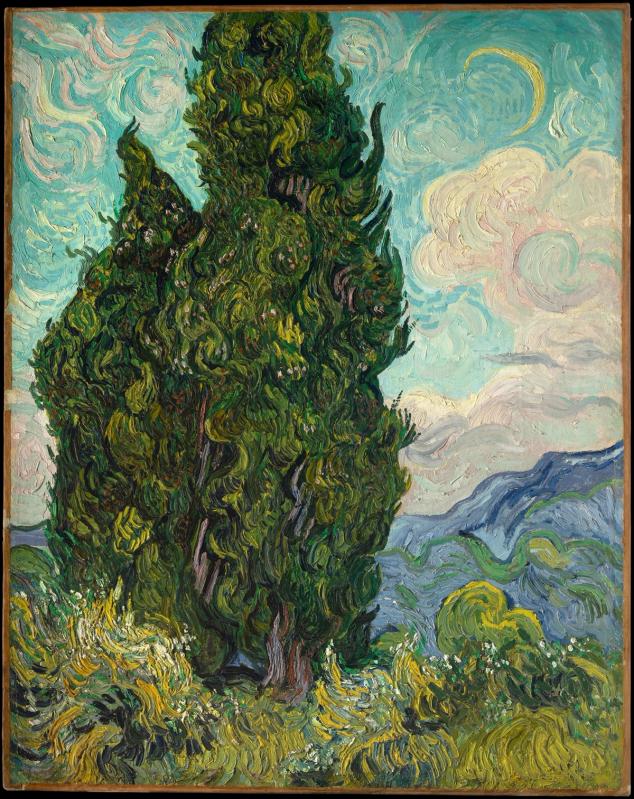
Vincent van Gogh’s Cypresses series is a significant part of his body of work, created during the final years of his life while he was living in the south of France. These paintings, which van Gogh produced between 1889 and 1890, are celebrated for their bold compositions, vibrant colors, and expressive brushwork. The cypress trees, with their towering, flame-like shapes, became a recurring motif in van Gogh's work, symbolizing for him both the natural beauty of the Provençal landscape and deeper themes of life and death.
Van Gogh’s fascination with cypress trees began during his stay at the Saint-Paul-de-Mausole asylum in Saint-Rémy-de-Provence. The trees, which are common in the Mediterranean region, particularly captured his imagination because of their distinctive shapes and the dramatic way they stood out against the sky. Van Gogh described the cypresses as “beautiful as regards lines and proportions, like an Egyptian obelisk,” highlighting their unique presence in the landscape (The Metropolitan Museum of Art).
One of the most famous paintings from this series is Wheatfield with Cypresses (1889), where van Gogh depicted the trees alongside a golden wheat field under a swirling sky. The painting is noted for its dynamic composition, with the cypress trees reaching upwards, echoing the undulating movement of the sky. The use of bold, contrasting colors—deep greens of the trees against the golden yellows of the wheat and the blues of the sky—creates a vibrant and harmonious scene that exemplifies van Gogh’s mastery of color and form. The cypresses in this painting, with their twisting forms and strong vertical presence, convey a sense of both stability and movement, reflecting van Gogh’s emotional intensity during this period (Encyclopedia Britannica) (Van Gogh Biography).
Another significant work in the series is Cypresses (1889), which features the trees as the central subject, standing against a turbulent sky. Here, van Gogh’s characteristic swirling brushstrokes are used to great effect, giving the trees a sense of life and energy. The cypress trees dominate the composition, their dark, towering forms contrasting sharply with the lighter sky, emphasizing their symbolic significance to van Gogh. These trees, which van Gogh associated with death and eternity, take on an almost mystical quality in this painting, reflecting the artist’s fascination with the natural world and his ongoing contemplation of existential themes (The Metropolitan Museum of Art).
Van Gogh’s cypress series also includes several smaller studies and drawings, where he continued to explore the forms and colors of the trees in different contexts. These works often show the trees as part of the broader landscape, integrated with the surrounding fields, hills, and skies of Provence. Through these studies, van Gogh experimented with different compositions and perspectives, deepening his connection to the subject and refining his artistic approach (Van Gogh Biography).
The Cypresses series is a powerful testament to van Gogh’s ability to transform simple elements of nature into profound expressions of emotion and spirituality. The series captures the essence of the Provençal landscape while also conveying van Gogh’s inner world, filled with both turbulence and beauty. Today, these works are among the most beloved in van Gogh’s oeuvre, celebrated for their technical brilliance and emotional depth (The Metropolitan Museum of Art) (Encyclopedia Britannica).