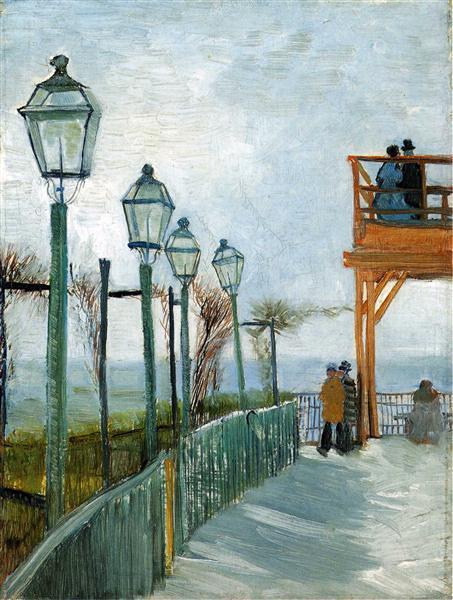
Vincent van Gogh's "Montmartre" series, created during his stay in Paris from 1886 to 1888, marks a pivotal period in his artistic development. This series of paintings and drawings captures the rapidly changing landscape of Montmartre, a district in Paris known for its bohemian atmosphere, windmills, and vibrant artistic community. Montmartre was then on the outskirts of Paris, offering a mix of urban life and rural scenery, which van Gogh found both inspiring and conducive to his evolving style.
In this series, van Gogh depicted the windmills, gardens, and streets of Montmartre with a new sense of color and light that he began to explore in Paris. His earlier works had been dominated by dark, earthy tones, reflecting the somber realities of peasant life. However, the influence of the Impressionists and Neo-Impressionists in Paris led him to adopt a brighter palette and a more dynamic approach to composition. Paintings such as "The Hill of Montmartre with Stone Quarry" (1886) and "View of Montmartre with Windmills" (1887) demonstrate his transition toward using lighter tones and more expressive brushwork (Encyclopedia Britannica) (World History Encyclopedia).
Van Gogh was particularly drawn to the windmills of Montmartre, which were a prominent feature of the district's landscape. These windmills, remnants of Montmartre's rural past, served as a symbol of the area's history and its contrast with the modernity encroaching upon it. In works like "Le Moulin de la Galette" and "The Blute-Fin Mill," van Gogh captured these structures with a mix of realism and the emerging boldness of his style. The windmills are often set against a backdrop of expansive skies, with attention to the effects of light and atmosphere, reflecting the influence of the Impressionist emphasis on plein air painting (vangoghgallery) (World History Encyclopedia).
The Montmartre series also includes scenes of the gardens and allotments that dotted the area, such as in "Vegetable Gardens in Montmartre" (1887). These works showcase van Gogh's growing interest in capturing the vibrant life of the natural world within an urban setting. His brushwork became more spontaneous, and his use of color more daring, as he sought to convey the vitality of the gardens and the changing seasons.
In addition to the landscapes, van Gogh's Montmartre series includes a few portrayals of the bustling life of the district. For instance, "La Guinguette" (1886) depicts a lively scene in one of Montmartre's popular outdoor dance halls, where Parisians of various backgrounds gathered for entertainment. These scenes allowed van Gogh to explore different aspects of Parisian life, from the tranquility of the gardens to the energy of the social gatherings (vangoghgallery).
The Montmartre series is a testament to van Gogh's artistic evolution during his Paris years. It reflects his experimentation with color, light, and form, and his ability to capture the essence of a place undergoing transformation. These works are not only valuable for their artistic merit but also for their documentation of a district that was central to the cultural life of Paris at the time (World History Encyclopedia).