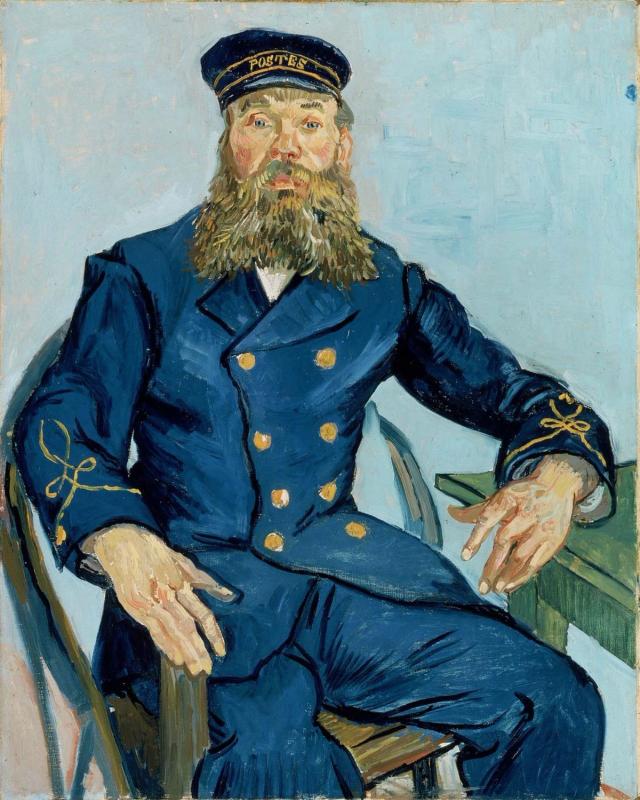
Vincent van Gogh's "The Roulin Family" series is a poignant and intimate collection of portraits that the artist created between 1888 and 1889 while living in Arles, France. The series centers on Joseph Roulin, a local postman and one of van Gogh's closest friends during his time in Arles, as well as Roulin's family members. Van Gogh painted multiple versions of each family member, creating a visual record of his deep affection for them and his unique ability to capture their personalities through his vibrant use of color and expressive brushwork.
The central figure in this series is Joseph Roulin, whom van Gogh painted in several different poses and settings. The most famous of these is "Portrait of the Postman Joseph Roulin" (1888), where Roulin is depicted in his uniform, with a full beard and a serious, thoughtful expression. Van Gogh admired Roulin for his strong character and kindness, qualities that he sought to convey through the bold use of color and the strength of the brushstrokes. The background is a vivid shade of blue, which contrasts sharply with Roulin's dark green uniform, emphasizing his presence and the respect van Gogh felt for him (The Metropolitan Museum of Art).
In addition to Joseph Roulin, van Gogh also painted his wife, Augusta Roulin, and their three children: Armand, Camille, and Marcelle. Each portrait is marked by van Gogh’s sensitivity to the individual personalities of his subjects. For instance, "Madame Roulin with Her Baby" (1888) portrays Augusta as a nurturing mother, holding her infant daughter, Marcelle. The composition is simple, yet the bright yellow background and the expressive lines create a sense of warmth and intimacy. Van Gogh's use of color in this painting, particularly the interplay between the yellows and greens, serves to enhance the emotional connection between mother and child (The Metropolitan Museum of Art) (vangoghgallery).
Van Gogh also painted Armand Roulin, the eldest son, in a series of portraits that reflect the young man’s somber and introspective nature. In "Portrait of Armand Roulin" (1888), van Gogh used a muted color palette of browns and greens, with a focus on the boy's serious expression and the detailed rendering of his features. These portraits are less vibrant than those of Joseph Roulin, perhaps reflecting Armand’s reserved personality compared to his father’s more extroverted demeanor (Van Gogh Biography).
Camille Roulin, the middle child, is depicted in several studies as well. "Portrait of Camille Roulin" (1888) shows the boy in a simple setting, his youthful face framed by short, dark hair. Van Gogh’s brushwork here is particularly lively, capturing the energy and innocence of youth. The bright, contrasting colors add a sense of vibrancy to the portrait, reflecting the liveliness that van Gogh saw in Camille (The Metropolitan Museum of Art).
The final member of the family, Marcelle Roulin, is portrayed both as an infant in her mother’s arms and as a young child in other studies. In these portraits, van Gogh captures the tenderness of early childhood with his characteristic use of warm, inviting colors and soft, flowing lines. The portraits of Marcelle, especially when she is held by her mother, convey a deep sense of familial love and the quiet joys of domestic life (vangoghgallery).
"The Roulin Family" series stands out not only for its artistic merit but also for the emotional depth it reveals about van Gogh's relationships with those around him. Through these portraits, van Gogh not only honored his friend Joseph Roulin but also explored the themes of family, friendship, and human connection, making the series one of the most personal and touching of his works (The Metropolitan Museum of Art) (vangoghgallery).